Trucker Per Diem for 2026-2027: Rates and Records
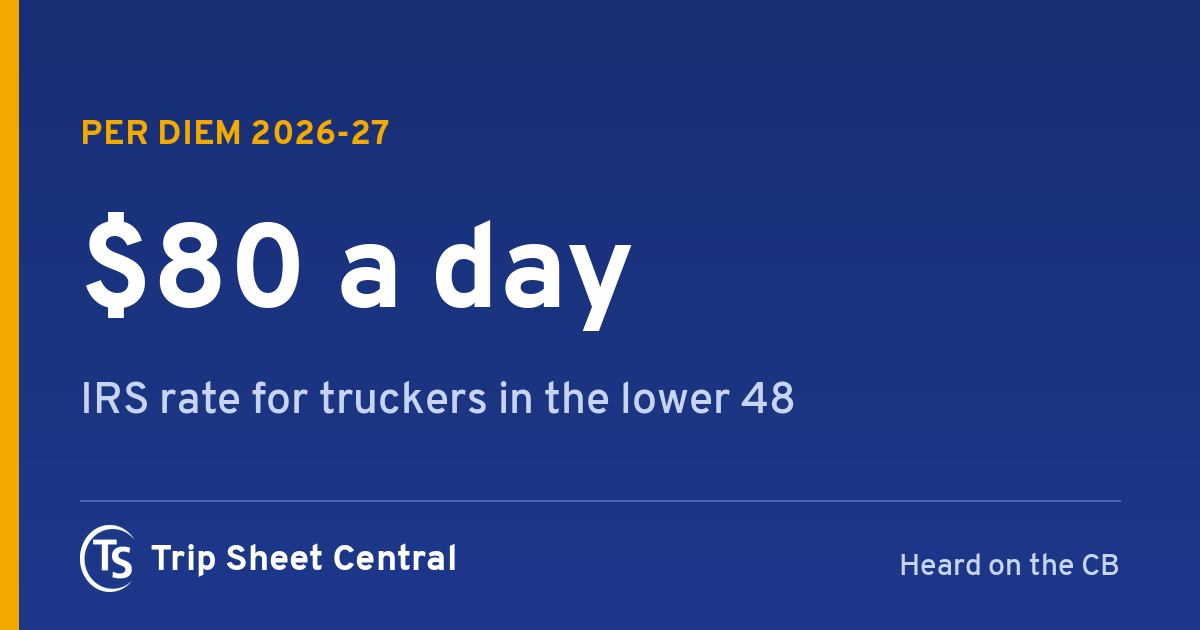
For travel from October 1, 2026 through September 30, 2027, the IRS special per diem rate for the transportation industry stays at $80 a day within the continental United States and $86 a day outside it. Many drivers use it to claim meals and incidentals while away from home. Here is how it works and what records you need.
The rates
- Special transportation rate, continental US: $80 per day.
- Special transportation rate, outside the continental US: $86 per day.
- Incidental expenses only: $5 per day, for travel in or outside the continental US.
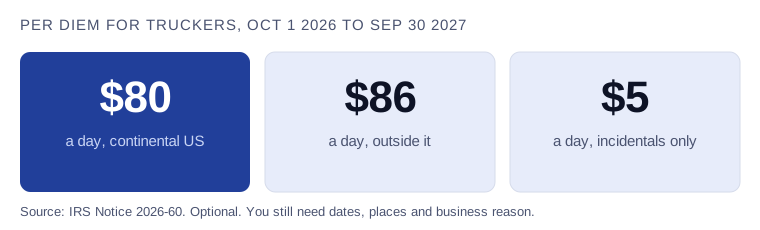
The IRS published these in Notice 2026-60. They are the same as the previous year.
What the per diem replaces
With the per diem method you do not keep every meal receipt. You count the days you were traveling away from home and multiply by the rate. The use of per diem is optional. You can instead deduct your actual meal costs if you keep complete records.
The 80 percent rule
Most business meals are only 50 percent deductible. IRS Publication 463 allows 80 percent for people subject to Department of Transportation hours-of-service limits, which includes interstate truck drivers. The publication is written around the DOT rules a person is under, and it is worth reading the current edition to see how it applies to your own situation.
What you still need to record
A per diem is only as good as the proof of travel behind it. Keep for each trip:
- The dates you left and returned.
- Where you traveled, which your trip sheets already show.
- The business reason, which is the load.
Count each day away from home accurately. A partial day counts as part of a day, so check the IRS publication for how to handle the first and last day of a trip.
Trip sheets make this easy. When every trip has dates, a route and a load, the days-away count for the year is a total, not a reconstruction. In Trip Sheet Central the trip dates are already part of the record you keep for IFTA and invoicing.
Tax questions
How the deduction works on your own return depends on your business type and your income. Your tax preparer should have the final say on which method gives you the better result. The numbers and the rules above come from the IRS, linked below.
Related: what a trip sheet is and why you need one.